

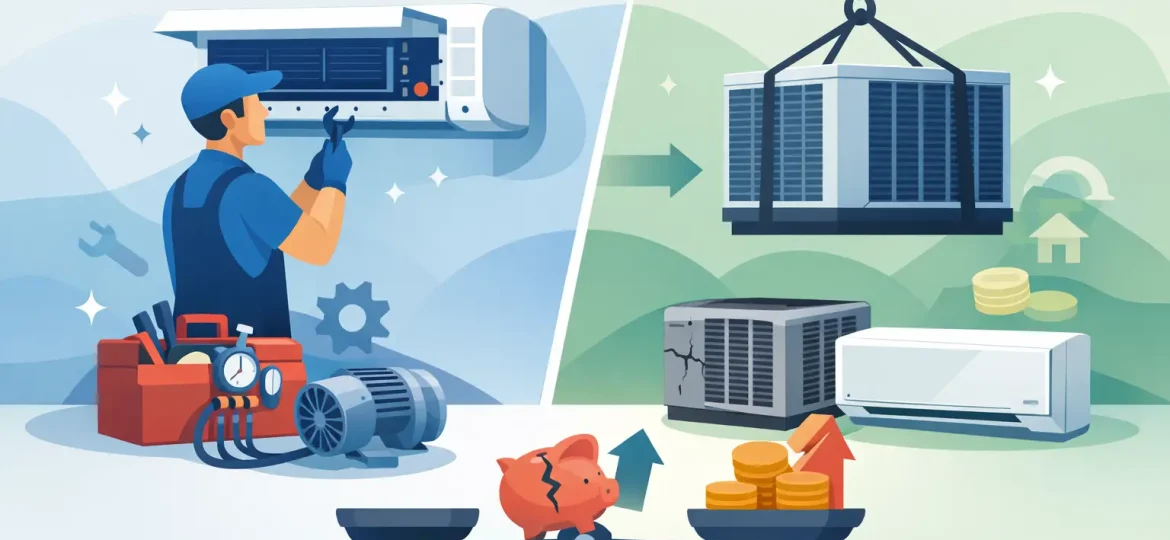
When your AC quits during a Los Angeles heat wave, the question gets real fast: what makes more sense, ac repair versus replacement cost? For most homeowners, this is not just about the lowest invoice today. It is about avoiding repeat breakdowns, keeping energy bills under control, and making sure your home gets cool again without wasting money.
AC repair versus replacement cost starts with the system’s age
Age is usually the first filter. A newer system with a single failed part is often worth repairing, especially if the equipment has been reliable up to that point. If your air conditioner is only a few years old, replacing the entire system is usually hard to justify unless there is a major compressor failure or a warranty issue that changes the math.
Once a system gets closer to 10 to 15 years old, the decision becomes less straightforward. At that stage, even if one repair seems affordable, you also have to consider what may fail next. Older systems tend to stack problems. Capacitors, contactors, fan motors, blower components, and refrigerant-related issues can show up one after another, and those costs add up quickly.
In Southern California, where many homeowners run AC hard through long warm seasons, wear can show up sooner if the unit has had inconsistent maintenance. A system’s age does not automatically mean replacement, but it does raise the standard for what counts as a smart repair.
What repair costs usually mean in real life
Repair pricing depends on the failed part, the brand, system access, and whether the issue is electrical, mechanical, or refrigerant-related. A minor repair can be very reasonable. A major repair can get expensive fast, especially when labor and hard-to-source parts are involved.
The bigger issue is not always the first repair bill. It is whether that repair actually buys you dependable service. If you spend a few hundred dollars and get several more years from the system, that can be money well spent. If you spend a similar amount and the unit breaks again next month, that is where frustration and cost start to snowball.
This is why a proper diagnosis matters. Homeowners are often told they need a full replacement when the real issue is a failed capacitor, dirty condenser coil, bad thermostat, or worn contactor. On the other hand, some repairs look affordable on paper but are attached to systems that are already losing efficiency, low on refrigerant, or showing signs of compressor stress. In those cases, the lower short-term cost can be misleading.
When replacement cost makes more financial sense
Replacement usually makes more sense when the system is old, inefficient, and facing a high-cost repair. If the compressor fails on a system near the end of its expected life, many homeowners decide not to put significant money into equipment that may not last much longer anyway.
Higher utility bills also play a role. An aging AC unit can still run, but it may cool slowly, cycle longer, and use much more electricity than a newer system. In areas like the San Fernando Valley, where summer temperatures can stay high for days at a time, efficiency matters. A replacement can reduce monthly operating costs, improve airflow, and provide more reliable comfort.
That said, replacement is still a larger upfront investment. It is not the right answer for every household or every unit. If your system has been dependable and the needed repair is targeted and reasonable, repairing it may still be the better value.
The 50 percent rule is useful, but not perfect
You may hear a common rule of thumb: if the repair costs about 50 percent of what replacement would cost, replace the system. That can be a helpful checkpoint, but it should not be treated like a hard law.
A 12-year-old system needing an expensive motor or refrigerant repair is very different from a 6-year-old system with the same repair estimate. The older system is much closer to the point where another major failure could follow. The newer one may still have enough service life left to justify the repair.
The same is true if your system has had multiple service calls in the last year. Even if each repair by itself seemed manageable, the pattern matters. Frequent breakdowns are a sign that your actual ownership cost is rising beyond the invoice in front of you.
Repair versus replacement depends on refrigerant, too
Refrigerant can heavily affect ac repair versus replacement cost, especially on older systems. If your unit uses an older refrigerant and has a leak, repair costs can climb because finding and fixing the leak is only part of the job. Recharge costs may be higher, and future refrigerant-related service may become less practical over time.
A small, repairable leak on a newer system may still make sense to fix. But a leaking older unit with declining efficiency is often a different story. At that point, homeowners are not just paying for the leak repair. They are paying to keep an outdated system alive.
This is one of the clearest examples of why a low estimate does not always mean low total cost. An older AC may be repairable, but that does not always make it a good investment.
Comfort problems are part of the cost
Homeowners usually focus on the invoice, but comfort issues matter, too. If your AC runs constantly but certain rooms stay hot, humidity feels off, or airflow is weak, you may be dealing with more than a simple part failure.
A replacement can solve larger system performance issues if the old equipment is undersized, oversized, or simply worn down. Repair can restore operation, but it may not fully restore comfort if the unit has broader efficiency or airflow limitations.
This matters for busy households in places like Encino, Glendale, Pasadena, and Santa Monica, where losing AC is not just inconvenient. It affects sleep, work-from-home schedules, kids, pets, and daily routines. The cheapest option is not always the one that gets your home back to normal fastest and most reliably.
How homeowners can make the right call
The best decision usually comes from looking at five things together: system age, repair cost, repair history, energy performance, and overall condition. One factor alone rarely tells the whole story.
If your air conditioner is under 10 years old, has been reliable, and needs a straightforward repair, repairing is often the smart move. If it is older, struggling to keep up, and facing a costly repair, replacement may protect you from pouring more money into a system that is already on borrowed time.
It also helps to ask one practical question: after this repair, what should you realistically expect? If the answer is a solid chance at a few more dependable seasons, repair may be worth it. If the answer is more uncertainty, more noise, higher bills, and a fair chance of another service call soon, replacement starts looking more reasonable.
A trustworthy technician should be able to explain that clearly without pressure. You want a diagnosis that shows what failed, what it costs to fix, and whether the rest of the system still has value. That kind of transparency matters more than any generic online rule.
AC repair versus replacement cost in Los Angeles homes
In Los Angeles-area homes, fast service matters because heat problems can escalate quickly. But speed should not come at the expense of judgment. A same-day repair that makes sense is a win. A rushed repair on a failing unit can leave you paying twice.
That is why many homeowners choose experienced local companies that can evaluate both paths honestly. A repair-first mindset is helpful when the system deserves it. A replacement recommendation should come when the numbers and condition support it, not as the default answer.
At World Appliance Service Co, that is the practical approach homeowners expect. The goal is to restore comfort quickly, keep costs reasonable, and recommend repair or replacement based on what truly serves the home best.
If your AC is failing, the smartest next step is not guessing from the thermostat or betting on one more hot weekend. It is getting a clear diagnosis, real numbers, and a recommendation you can trust before the next breakdown makes the decision for you.
