

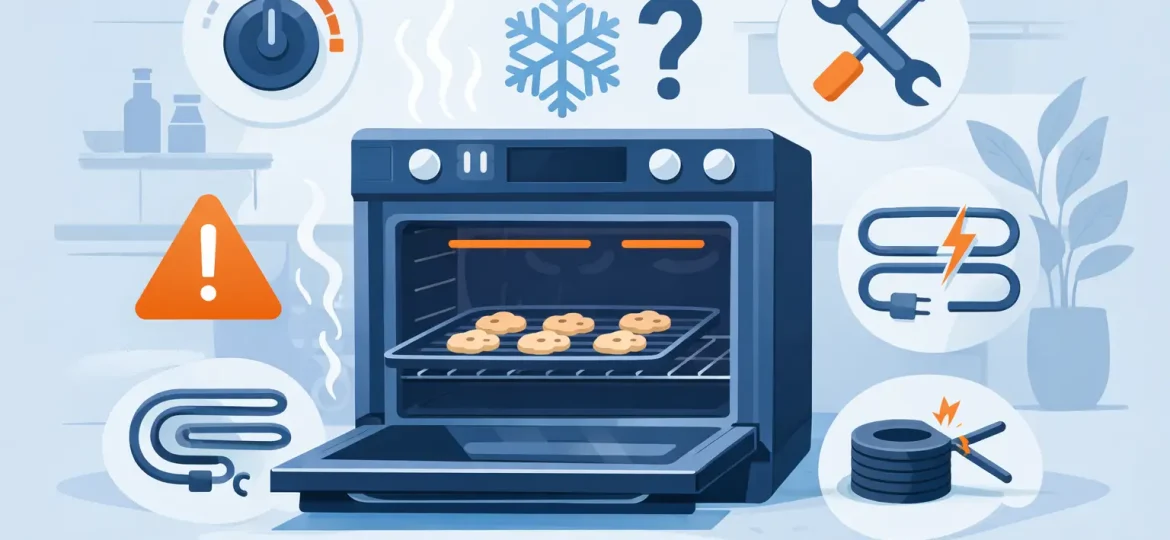
Dinner is prepped, the pan is ready, and then nothing happens. If you’re asking why is oven not heating, the problem usually comes down to a failed heating part, a power issue, or a control problem that needs a proper diagnosis.
For busy Los Angeles households, an oven that will not heat is more than an inconvenience. It throws off dinner, meal prep, entertaining, and the whole rhythm of the day. Some issues are straightforward. Others can look simple on the surface but involve wiring, sensors, or control boards that require an experienced technician.
Why is oven not heating in the first place?
An oven needs several parts to work together at the same time. It has to receive the right power, send commands through the control system, and activate the bake or broil components at the right temperature. When one of those pieces fails, the oven may stay cold, heat weakly, or take far too long to reach the set temperature.
On electric ovens, the most common issue is a failed bake element or broil element. On gas models, the igniter is often the first part to suspect. But that is not the whole story. A damaged sensor, faulty thermostat, broken relay, loose wiring, or even an incorrect incoming voltage can create similar symptoms.
That is why the same complaint – oven not heating – can have very different repair paths depending on the brand, model, and fuel type.
The most common reasons an oven stops heating
Failed bake element in an electric oven
If your electric oven turns on but does not get hot, the bake element is one of the first components to check. This is the lower heating element inside the oven cavity. When it burns out, you may notice visible blistering, cracks, or areas that look broken or separated.
Sometimes the failure is obvious. Sometimes the element looks normal but still does not heat. In that case, testing for continuity and confirming power supply becomes necessary. Replacing the element may solve the problem, but only if the element itself is the failed part. A control or wiring issue can produce the same symptom.
Weak or failed igniter in a gas oven
On gas ovens, a weak igniter is a very common cause of no heat. The igniter has to draw the correct current to open the gas valve. If it glows but is too weak, the oven may never ignite properly. Homeowners often assume that because the igniter glows, it must be working. That is not always true.
This is one reason gas oven diagnosis can be tricky without experience. A glowing igniter can still be the problem, and replacing the wrong part wastes time and money.
Bad temperature sensor
The oven sensor monitors interior temperature and communicates with the control board. If the sensor is out of range or fails completely, the oven may not heat correctly, may overheat, or may shut heating off too soon.
A bad sensor can create inconsistent symptoms. One day the oven seems slow. The next day it does not heat at all. That kind of unpredictability usually points to a part that is drifting out of spec rather than a total mechanical failure.
Control board or thermostat trouble
Modern ovens rely on electronic controls to manage heating cycles. If the control board fails, the oven may not send power to the bake element, broil element, or igniter. Older models may use a thermostat or selector switch that wears out over time.
This is where brand-specific experience matters. Premium and built-in ovens often have more complex control systems, and the repair may involve more than swapping a single part. Proper testing is the difference between an accurate repair and a return visit.
Power supply problems
If an electric oven has partial power, the clock or display may still work while the oven does not heat. Many homeowners find that confusing. The appliance appears to have power, but it cannot produce heat because it is not receiving the full voltage it needs.
This can happen because of a tripped breaker, damaged terminal block, loose power cord connection, or internal wiring issue. In some cases, the oven may heat very weakly instead of not heating at all.
Door switch, thermal fuse, or safety cutoff failure
Some ovens have safety components that stop heating if the unit overheats or detects a problem. A failed thermal fuse or related safety part can interrupt the heating circuit. Door lock and door switch issues may also interfere with normal operation, especially on self-cleaning models.
These are not the most common repairs, but they do come up, especially after a self-clean cycle or after years of heavy use.
Why the oven may heat a little, but not enough
Not every no-heat call is truly a no-heat problem. Sometimes the oven warms slightly but never reaches the set temperature. Other times it takes an hour to preheat or cooks unevenly.
That usually points to a component that is failing rather than fully dead. A weak igniter, partially working element, drifting sensor, or damaged relay can all produce low or inconsistent heat. If the broiler still works but bake does not, that narrows the diagnosis. If both functions fail, the issue may be power-related or tied to the control system.
It depends on the pattern. Good diagnosis starts with the exact symptom, not just the complaint that the oven is not working.
What to do when you notice the oven is not heating
Start with the basics. Make sure the oven is actually set to bake or broil, not delay start or another mode. Check the breaker if the unit is electric. If the display is blank, the problem may be a full power loss. If the display is on but there is no heat, that points in a different direction.
Beyond that, most homeowners are better off scheduling service instead of trying to take the oven apart. Ovens involve high voltage, gas components, and sensitive electronics. What looks like a simple heating problem can turn into a safety issue very quickly.
Trying to guess the part is also expensive. We often see customers who have already replaced an element or igniter, only to find out the real problem was a relay, sensor, or wiring fault.
When to call for professional oven repair
If the oven will not heat at all, trips the breaker, smells like gas, sparks, or heats unpredictably, it is time for service. The same is true if you own a premium brand or built-in wall oven where parts access and calibration are more involved.
Fast diagnosis matters because oven problems usually do not fix themselves. In many cases, the failed part gets worse over time. A weak igniter can become a complete no-heat condition. A damaged element can short out. A loose electrical connection can cause further damage to surrounding components.
For homeowners in Los Angeles, the San Fernando Valley, Oxnard, and Ventura County, speed matters too. Waiting several days for a working oven is not ideal when you are managing work, school, and family routines. That is why same-day service is often the best path when the kitchen is down.
Why is oven not heating after self-clean?
This is a question technicians hear often. Self-clean cycles expose the oven to extreme heat, which can stress components that were already aging. After self-clean, it is common to see failures involving thermal fuses, door lock assemblies, control boards, and sensors.
That does not mean self-clean always causes damage, but it can push a weak part over the edge. If the oven stopped heating right after a cleaning cycle, mention that when you book service. It helps narrow the diagnosis faster.
The value of an accurate diagnosis
An oven repair should solve the problem once, not turn into a process of replacing parts until something works. The challenge with no-heat issues is that multiple failures can look the same from the outside. A cold oven does not tell you whether the problem is the element, igniter, board, sensor, wiring, or power supply.
That is where an experienced local repair company earns its value. World Appliance Service Co diagnoses and repairs major home appliances across the greater Los Angeles area, with the goal of getting your kitchen back to normal quickly and without unnecessary guesswork.
If your oven is not heating, the safest next step is to stop forcing it to run and have it checked properly. A fast repair today is usually easier and less costly than waiting until the problem spreads to other components. When the oven is part of your daily routine, getting it fixed right is not just convenient – it keeps the whole house moving.
